27 States Expand Pathways for Internationally Trained Physicians in 2026

The coastal community of Hoquiam, Washington, located about two hours from Seattle, is designated as a Health Professional Shortage Area, where demand for care outpaces the supply of health professionals. Many Hoquiam residents haven’t seen a physician in years.
Dr. Win Kyin is helping to change that. She attended medical school in Myanmar, where she spent more than a decade as a general practitioner running her own free clinic. Simultaneously she applied what she’d learned in graduate school earning a master’s in public health to her work of overseeing hospital management at Myanmar’s Ministry of Health.
When the military seized control of the government in February 2021, Dr. Kyin spoke out against the coup. Fleeing arrest, she left her clinic and patients behind. She arrived in the United States in January 2022—bringing her years of training and dedication to patient care with her.
“Taking care of patients as a physician is my childhood dream,” she said.
Dr. Kyin is exactly what communities like Hoquiam need. Yet validating her credentials was challenging due to the military coup, and she faced barriers in the U.S. licensing system. Despite years of education and experience practicing medicine, internationally trained physicians (ITPs) like Dr. Kyin are typically required to repeat their graduate medical education, also known as a medical residency. This structural barrier not only delays individual careers and prevents ITPs from contributing their skills and experience, it also leaves patients waiting. WES has documented this gap through credential evaluations and engagement with partners and ITPs on the ground, demonstrating that the barrier stems not from qualifications, but outdated systems. This expertise laid the groundwork for a national policy effort.
State Innovation Sparks a National Model
With a national physician shortage projected to reach 86,000 by 2036, states are leading the way in modernizing systems to unlock the talent already in their communities. WES has been part of that effort from the beginning—working alongside policymakers and partners on the ground to help draft model bill text, advance legislation, coordinate state and national partners, and support states as they move from passage to implementation.
While exploring her options, Dr. Kyin took a job as a pharmacy technician at Walgreens in Portland, Oregon, in March 2022, where she learned about the U.S. health care system and improved her English proficiency. Her administrative and public health background soon opened another door—the refugee organization that had connected her with the job at Walgreens hired her to oversee its community health programs. She managed a bilingual team serving patients from Afghanistan, Ethiopia, Myanmar, Russia, Ukraine, and more.
“It was a privilege for my professional life and my personal life,” Dr. Kyin said.
It was meaningful work, but Dr. Kyin wanted to return to practicing medicine—her lifelong dream and the career she had trained for. Washington State was working to make that possible, establishing an alternative pathway to licensure that didn’t require ITPs to repeat their training.
Washington’s pathway maintains rigorous standards while eliminating unnecessary barriers to practice. Rather than repeating years of training they’d already completed, ITPs could demonstrate their qualifications through a structured, supervised assessment period.
In 2021, Washington became the first state to enact legislation granting temporary licensure to ITPs. Five years later, in 2026, it updated this policy to eventually permit ITPs to transition to full licensure. States nationwide quickly followed suit. In 2022, Colorado opened up to ITPs a re-entry program initially designed for U.S.-educated physicians. Then, state by state, a trend emerged rooted in the idea that when immigrants can fully contribute their skills, everyone benefits. These states recognized the experience and education of immigrant health care providers, and designed pathways to connect these individuals with in-demand jobs that match their skills sooner.
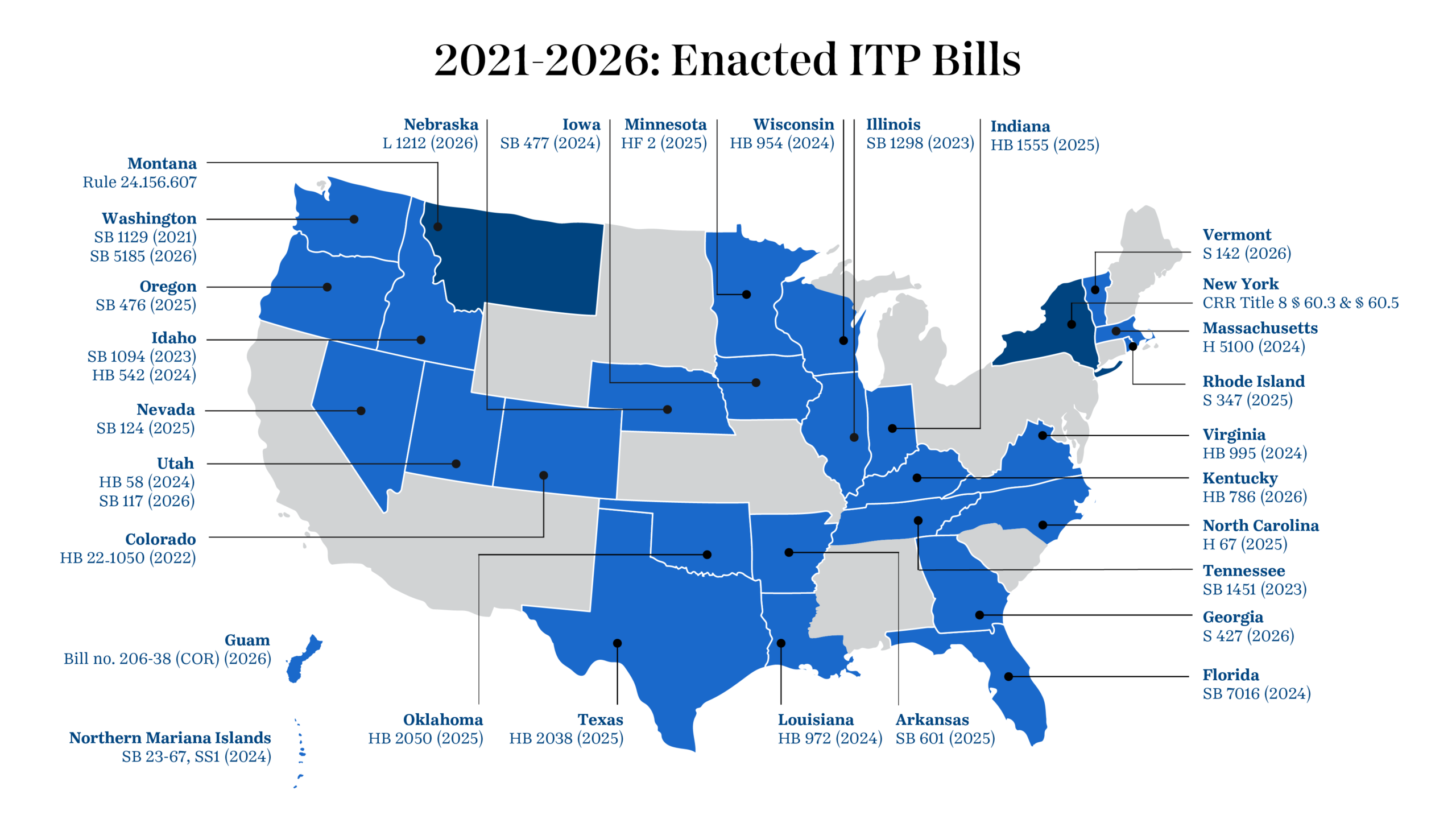
This year, 25 states had active legislation to create or strengthen alternative pathways to licensure for ITPs—spanning every region and political stripe.
As of May 2026, 27 states and two territories have passed alternative pathways to licensure with broad bipartisan support. As more states adopt these alternative pathways, best practices and commonalities have emerged, including minimum years of practice required, limits on how recently an applicant must have practiced, approved types of employers, requirements to serve in rural or underserved areas, and standardized assessment protocols.
From Policy to Practice
Passing a law is just the first step in ensuring that ITPs can serve communities in need. After legislation is signed, state medical boards or regulatory agencies typically define application requirements and assessment procedures. Once rules are finalized, agencies build or adapt the systems needed to accept and process applications. Recognizing the complexity and time-consuming nature of this process, WES has provided strategic guidance, technical expertise, and hands-on support to states at every stage of implementation. As a result, these pathways have created a pipeline of physician talent by empowering ITPs to meet licensure requirements and facilitating direct connections with employers.
Of the 27 states that now have provisional pathways to licensure, 13 have fully implemented them and are actively accepting applications from ITPs: Arkansas, Colorado, Florida, Idaho, Illinois, Indiana, Iowa Minnesota, Oklahoma, Tennessee, Texas, Washington, and Wisconsin. Most of these states began implementing these pathways in late 2025 and early 2026.
Licenses have been issued in Arkansas, Illinois, Louisiana, Tennessee, Washington, and Wisconsin.
Dr. Kyin received her initial license in January 2026 and within weeks accepted a position as a physician at a skilled nursing facility in Hoquiam. She is one of 50 ITPs now licensed through Washington’s pathway across a range of specialties—geriatric medicine, family medicine, internal medicine, pediatrics, psychology, and gastroenterology. Like Dr. Kyin, most of the state’s ITPs work in rural or underserved communities. The International Medical Graduates Academy shared internal survey data showing that ITP licensees in Washington have served more than 75,000 patients.
“We are happy to serve the community. We don’t mind staying in a small town. We just want to practice and help the community. And we just want to be involved in the health care system,” Dr. Kyin said.
The legislation that states are embracing not only modernizes systems so that immigrant doctors can fully contribute but also ensures that patients in communities like Hoquiam don’t go years without care.
Additional States Focus on Implementation
Early activity in other states also looks promising. Illinois issued four provisional licenses to ITPs, with 24 additional applicants currently under review. The first ITP to receive a license through Illinois’ pathway is an anesthesiologist working at a kidney care center. Louisiana issued its first license to a physician practicing in a rural hospital in a specialty where demand is high.
As more doctors apply for and receive a license to practice, it’s a sign that states can modernize or design systems that move immigrants from the margins into in-demand roles in their communities. The number of licenses is expected to grow as word spreads among eligible physicians, and as each new license makes a meaningful difference for patients and communities who need qualified doctors.
What Comes Next
While the momentum is real, the work to develop infrastructure that reliably connects communities with the care they need and immigrant talent with good work is far from finished. With lessons learned from successful campaigns, as well as from tackling challenges, states are drafting a consistent playbook to ensure that these laws are proposed, passed, enacted, and implemented across the country. The alternative pathway model, built on verified credentials, structured assessment, and supervised practice, offers replicable insights for other professions where immigrants face similar barriers. For those who share our commitment to this work, here are five areas ripe for increased engagement:
- Keep up Legislative and Regulatory Advocacy. Encourage passage of the bills still pending in 2026, develop strategies for success in targeted states for 2027, and continue pressing for effective implementation in states that have already passed legislation. Explore each state’s approach to crafting alternative pathways to licensure in WES’ journey map and bill comparison chart.
- Invest in Storytelling. Collect accounts from ITPs and the hospitals and clinics that hire them, documenting how these pathways are helping ITPs and the communities and individuals they serve.
- Share Data and Best Practices. Develop a process for data sharing so that states can exchange information on implementation, particularly on international training programs deemed substantially similar and successful vetting processes.
- Support State Partners. Provide technical support to states working to identify eligible ITPs, and connect them with interested employers.
- Build Nationwide Infrastructure. Develop relationships with national and state health care organizations to raise awareness of the pathways and create reliable pipelines for recruitment and hiring.
Policymakers, state leaders, and organizations interested in passing, implementing, or raising awareness around alternative licensure pathways can contact WES to explore how we can work together. Email us at [email protected].


Want to stay in the loop?
Sign up for our Newsletter. We’ll share updates, what we’re learning, and opportunities through our email list.